stories
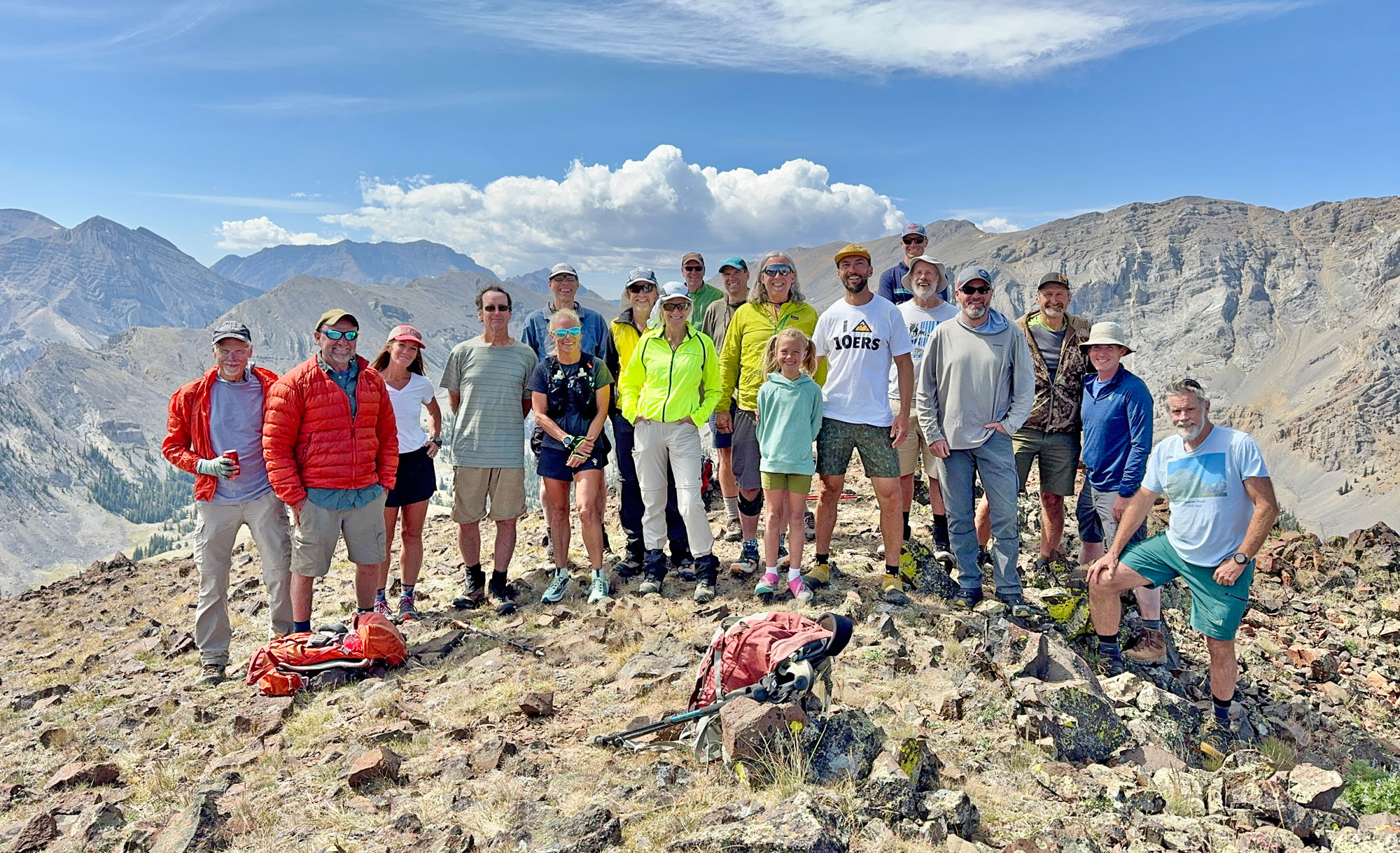
completion 🏁
My first 10er was Williams Peak in 2014—the year I moved to the Wood River Valley. Those first few years I was doing casual peakbagging that was more focused on local hills or taller peaks, so not too many 10ers. While I was working on the 11ers (which I finished in 2021), I would often tag adjacent 10ers. During that process I started getting more serious about collecting 10ers—but actually completing the list was at most a pipe dream. I’ve since repeated any 10ers I climbed prior to 2018 so my completion time for the list of 362 peaks is just over 7 years.


link-ups 🔗
When working on the 10ers list, rarely did I climb one peak at a time. I’m interested in efficiency, but I also want a challenge. There were instances when I was able to get on my first summit of the day within an hour of (steep) hiking—so of course I’m not going to hike back down then drive 3 hours back home. Once you’re up, stay up and get as much as you can! I enjoyed spending time at home looking at a map with all the peaks plotted, grouping them into logical clusters, then measuring out the hiking distance and vertical and adjusting from there. Generally I’m aiming for around 6000’ vertical feet in a day. After doing this for a long time, I can say that distance matters much less. The level of how strenuous a day in the mountains will be is largely based on the vert. My record was ten 10ers in a day at the north end of the Boulder Mountains.
I don’t publish GPX tracks anywhere, but any climber interested in spying on my link-ups can find them on Lists of John. From a peak detail page, navigate to ‘View Ascent Detail/Comments’ > ‘Total Peaks (same day)’.

Lemhis ⛰️
Nowhere was the link-up mentality more crucial than the Lemhi Range. With 103 10ers, nearly a third of the list is located within that one range, which stretches 100 miles from Salmon to Howe. The peaks there and generally quite easy to climb, and many are 3+ hours of driving from my home—so when I made trips to the Lemhis it was all about going big with endurance hikes. When working on the east side of the range, I would often set up camp in Leadore and get 2-3 days of climbing in. I believe I got 22 10ers done one weekend there.

injury 🏥
Despite decades of skateboarding and other wild antics, I made it to my 40s without ever breaking a bone. My luck ran out while pursuing the 10ers. We were in an ongoing cycle of afternoon storms which was putting a damper on peak outings. I had my one free day of the week when my daughter was with her grandmother so I was going to use it. I went for Peak 10273, directly above the old Phi Kappa mine. As expected, I got up to the summit in less than an hour. I signed the small Baugher register then heard the rumble of thunder. It was time for a quick escape.
I jogged over to my intended descent gully and headed down the scree. I had to pass through a section of football-sized rocks and I didn’t slow down as much as I needed to. I knew I was being reckless. I stepped down to a larger rock that rolled over under my weight. When my foot contacted the ground below my ankle rolled and I let out a groan of frustration as I toppled over. I stood back up and it registered that I had properly sprained my ankle. Then I took a few steps and felt it buckle a bit internally. “Okay, I broke something and I’ve got a long way to go. Time to focus and get through this”. I did some limping until I got down to smoother dirt then switched over to scooting down on my butt, hands, and one good foot. It didn’t take long for the storm to catch up to me. The rain never came down too hard, but I did endure two hail cycles and the thunder got uncomfortably close. Eventually the butt-scoot wasn’t working for the terrain so I found a walking stick and did whatever it took to keep moving. I only felt pain when I put weight on my foot—which was necessary in my predicament. I focused on my breathing and grunted through the pain as I hobbled down the mountain. A visit to the ER confirmed that I had snapped the bottom of my fibula. I hiked my next 10er 7 weeks later.

difficulty 🧗
Peak routes are rated using the Yosemite Decimal System:
- Class 1 (trail hiking)
- Class 2 (off-trail hiking)
- Class 3 (scrambling)
- Class 4 (scrambling with exposure)
- Class 5 (technical climbing)
Nearly all of the Idaho 10ers are class-2 or 3. While none have designated hiking trails to the top, there are two you can drive up (which I like to call class-0 😉): Dead Horse Summit (which has a communication tower) and Twin Peaks South (home to Idaho’s highest fire lookout). While I have driven to the top of them, I have also hiked up them. From Dead Horse Summit, I hiked down and over to Peak 9998—which means I had to then hike up D.H.S. to return to my 4×4. I had only driven up Twin Peaks South during a day of hiking to all of its neighbors that were on my hit list. After hearing a friend’s opinion, I decided I should return and actually hike to the top.

Almost all of the class-4 and class-5 peaks on the 10ers list are located within the Sawtooth Range. When I first started considering completing the 10ers, I would experience anxiety thinking about the more difficult Sawtooth Peaks—Warbonnet in particular. More on that in the Sawtooths page. In the end I roped up for four of the 10ers, but there are a few more that some climbers would prefer to rope up for. Within the Top 500, I also roped up for one 11er and two 9ers.

9ers ⛰️
Finishing the Idaho 12ers, 11ers, and 10ers was going to put me at the 486 highest peaks in the state. It only seems logical to push that to an even 500 (plus there’s a spinning star on the line in my Lists of John stats profile 😁). Adding 14 peaks that are lower than all the others sounds easy enough, but the bottom of the list threw me some curveballs. At #497-501 there’s a 5-way tie of 9980 peaks. This is a common elevation because peaks that end in a 9960’ contour without a spot elevation on the summit (or LiDAR elevation available) get an interpolated elevation of 9980’. Three of these had no known ascents and were in the Sawtooths—so I expected some challenges.
9ERS SUMMIT PHOTOS GALLERY
“McWillards Peak” at the head of Goat Creek is deep within the range. Not just far from trailheads but far from any trail. For years it had been mislabeled on Lists of John as “La Fiamma”—a ridiculously challenging spire climbed by Fred Beckey. I imagine this deterred peakbaggers from checking it out. I was able to attempt McWillards Peak during my one backpacking trip of this project, on a day when I was climbing several other peaks in the area. I was easily able to scramble to the summit with only mild exposure.

“Red Sentinel” northeast of “Le Bec D’Aigle” also had a bit of a deceiving label. In Tom Lopez’s guidebook, “Red Sentinel” was stated to be feature as “Flatrock Needle”—which has been described as “an airy aid climb up the intimidating pillar” [REF] and “the most difficult first ascent of the (Iowa Mountaineers 1960) outing” [REF]. Our ascent began the investigation of a case of mistaken identity, because we were able to scramble a class 4+ route to the summit boulder which entailed a couple easy class-5 moves. Tom later reviewed his notes and determined that Red Sentinel and Flatrock Needle were two different features. The name Red Sentinel was proposed by the late Lyman Dye, although he never reported climbing it. As of 2025 ours is still the only known ascent.

Peak 9980 southwest of Braxon Peak was the real troublemaker. Going into this year, I had finished all the technical 10ers and knew the 10er completion was in the bag. I had the hopes of finishing the Top 500 as well, but I wasn’t sure that was going to happen. I had already attempted this peak 3 times. For comparison, my success rate on summits is at least 98%. I’m a good planner, I know what I’m capable of, and I’m very persistent. This one was just hitting different.

Attempt 1: Solo mission. After climbing “Rhino Perch” (the stiffest class-4 on this list), I went over to investigate 9980. I was able to scramble to within 60’ of the summit where I encountered a technical section. Looked like smooth sailing after that though.
Attempt 2: Came back with a partner and a rope. Got through the first pitch. Then realized the true nature of the summit block had been hidden from us. It looked tough. We left.
Attempt 3: Returned with a strong climber hoping he could get up a slab on the summit block. Upon closer inspection, that slab was near impossible and a fall meant a pendulum into a wall. Another side of the summit block looked more promising, but we didn’t think we could get any protection on it. The vibe just didn’t feel right, so we left.
Attempt 4: About 6 weeks before I was scheduled to hike my last 10er with friends, I made it out once again with Kaden Platt. I was pretty certain the results of this day would determine if I would attain my Top 500 goal—not just now but possibly ever. We brought climbing gear that we wouldn’t normally carry. This proved beneficial, because Kaden used two ball nuts as protection in the tiny cracks that were available. I would have been satisfied to aid climb this peak (using the rope or placed gear to ascend), but I was able to free climb (using the rope only for protection) up the summit block. That also meant I free climbed every peak in the Top 500 list. That day felt good.

mystery peaks 🤔
There were a few mysterious peaks on this list that had no known ascents within the peakbagging community (nor any physical evidence of visitation). This is based on the main peakbagging databases, Lists of John and Peakbagger, as well as Tom Lopez’s diligent research in collecting climbing information and history for his guidebook, Idaho: A Climbing Guide. Tom continues this work for the accompanying website. The vast majority of summits have a cairn on the top—usually marking the highpoint and also serving as a subtle mark that people have been there. On technical peaks, you’ll find webbing or cord that previous climbers rappelled from. After a rappel, the rope is retrieved but the material constructing the anchor is not. The history of previous visitors to these peaks will likely remain a mystery, but it’s plausible that at some point I topped out on mountain that had never been climbed.
“Judas Peak” 10,328’ – 7/10/2019
This was my first time venturing out to a peak with no known ascents, so I was excited when it worked out. Unfortunately the topo map was way off and LiDAR revealed that it lacked the prominence to be a ranked 10er (not even close, actually)
“East Thompson” 10,315’ – 8/21/2022
This collection of towers is the subject of many photographs taking by hikers on their way to Thompson Peak, but it didn’t seem like anyone had ever made it up there. Extreme skiers take to its steep couloirs, but tagging the summit from the top of those ski lines is out of the question. Read more on the ‘Selects’ page.

“Long Tom Peak” 10,266′ – 6/10/2020
This one is tucked away in the Boulders and accessing it requires going up, down, and back up again—plus the same on the way out. A pack trail runs through the tight valley below.
“Hidden Lake Peak” 10,059’ – 9/6/2020
This is a long way to access from any direction. The final moves were a little exposed but nothing too crazy.

Also, within the Top 500:
“Ibex Creek Peak” 11,195’ – 10/07/2023
When I first starting doing LiDAR analysis I discovered this peak has 307’ of prominence. The maps were off enough that it wasn’t even on anyone’s radar as a potential ranked peak. Within a matter of days, I went out there to check it out before the snow starting flying that year. Its location in the Boulders makes it difficult to access, and its summit sits 4000 vertical feet above the valley below.
“McWillards Peak” – 7/5/2024 (see above: 9ers) This one is simply a ways out from any trailhead.
Peak 9980 – 7/8/2025 (see above: 9ers) After the 5.7 summit pitch, we found a cairn on the summit but no rap anchor. The final move is a slightly overhanging mantle with no hand holds. Downclimbing seems out of the question. Perhaps the old tat rotted and blew away? Maybe the summit block changed in the 2020 earthquake—since the side we climbed looked like it could be a fresh shear and the face of the mountain is covered with what appears to be dirt and rubble. A mystery, indeed.
“Red Sentinel” – 8/18/2024
(see above: 9ers) This summit is not far from Redfish Creek so a steep bushwhack is the only barrier to access. The name was proposed by Lyman Dye but no ascents were ever reported.
